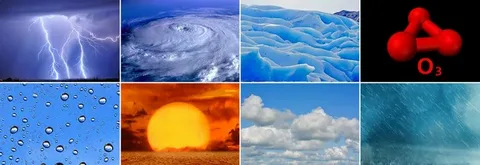
50 Interesting facts about weather and climate.
Here is a unique and engaging list of 50 interesting facts about weather and climate, showcasing the wonders, extremes, and science behind our planet’s atmosphere.
- The sun is the main driver of all weather and climate on Earth.
- The hottest temperature ever recorded was 56.7°C (134°F) in Death Valley, USA, in 1913.
- The coldest temperature was -89.2°C (-128°F) at Vostok Station, Antarctica, in 1983.
- The Lut Desert in Iran is often the hottest spot on Earth, with ground temperatures reaching 70.7°C (159°F).
- Lightning strikes the Earth about 100 times every second—that’s over 8 million strikes a day!
- A single lightning bolt can heat the air to 30,000°C (54,000°F), hotter than the surface of the sun.
- Raindrops are not tear-shaped; they start spherical and flatten as they fall.
- The rainiest place on Earth is Mawsynram, India, with an average annual rainfall of over 11 meters (467 inches).
- About one billion tons of rain falls on Earth every minute.
- The windiest place is Commonwealth Bay, Antarctica, with average winds of 80 km/h (50 mph) and gusts over 240 km/h (150 mph).
- Tornadoes can have wind speeds up to 480 km/h (300 mph).
- The U.S. “Tornado Alley” sees over 1,000 tornadoes a year.
- Waterspouts are tornadoes that form over water.
- The largest hurricane ever recorded was Typhoon Tip (1979), with a diameter of 2,220 km (1,380 miles).
- Hurricanes, typhoons, and cyclones are the same type of storm—just named differently depending on location.
- The Mississippi River once froze solid from source to mouth in 1899.
- Snowflakes can take up to an hour to reach the ground.
- No two snowflakes are exactly alike.
- The River Thames in London froze solid for two months during the Great Freeze of 1684.
- Snow absorbs sound, making the world seem eerily quiet after a heavy snowfall.
- The ozone layer protects us from harmful UV rays but is toxic to breathe.
- Antarctica is the largest desert in the world, getting less than 200 mm (8 inches) of precipitation per year.
- The entire continent of Antarctica is covered by a single continental glacier.
- The air we breathe is 78% nitrogen and only 21% oxygen.
- The jet stream can reach speeds of over 400 km/h (250 mph).
- The first weather forecast was published in The Times (London) in 1861.
- The word “meteorology” comes from Greek words meaning “study of things in the sky.”
- The main types of weather are: wind, humidity, precipitation, temperature, pressure, and cloudiness.
- A warm front can cause gentle, steady rain.
- A cold front often brings sudden storms and cooler air.
- The Earth’s atmosphere weighs about 5.5 quadrillion tons.
- The highest clouds (cirrus) form at 8–15 km (5–9 miles) above Earth.
- The lowest clouds (stratus) can form right above the ground as fog.
- The driest place on Earth is the Atacama Desert in Chile; some weather stations have never recorded rain.
- The wettest 24-hour period was in Cilaos, Réunion (1952), with 1,825 mm (71.9 inches) of rain.
- The fastest temperature rise was in Spearfish, South Dakota: from -20°C (-4°F) to +7°C (45°F) in two minutes (1943).
- The slowest temperature rise was in Fairbanks, Alaska: from -34°C (-29°F) to -6°C (21°F) in 15 hours (1969).
- The deadliest blizzard was in Iran (1972), burying 200 villages under 8 meters (26 feet) of snow.
- The largest hailstone ever recorded weighed 1.02 kg (2.25 lbs) and fell in Bangladesh (1986).
- The most snowfall in a season was at Mount Baker, Washington (1998–99): 2,896 cm (1,140 inches).
- The hottest ocean surface temperature recorded was 36°C (96.8°F) in the Persian Gulf.
- The coldest ocean water is found in Antarctic bottom water, around -2°C (28°F).
- The driest continent after Antarctica is Australia.
- The wettest continent is South America (Amazon Basin).
- The most common mineral in rainwater is calcium carbonate.
- The world’s longest lightning bolt stretched 768 km (477 miles) across Brazil (2018).
- The most lightning-prone place is Lake Maracaibo, Venezuela (“Catatumbo lightning”).
- The highest permanent human settlement is La Rinconada, Peru (5,100 m/16,700 ft), with extreme weather.
- The most extreme temperature range in one day: Loma, Montana (1972): from -48°C (-54°F) to +9°C (+48°F).
- Climate change is making extreme weather events more frequent and intense worldwide.