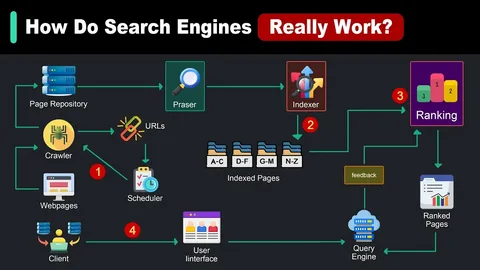
How search engines work.
The Inner Workings of a Search Engine: A Digital Librarian
A search engine is a complex, multi-stage system designed to sift through the billions of pages on the internet and deliver the most relevant answer to a user's query in a fraction of a second. This process is not magic, but a carefully orchestrated symphony of software bots, massive databases, and sophisticated algorithms.
The entire process can be broken down into three primary functions: Crawling, Indexing, and Ranking/Retrieval.
▌ 1. Crawling: The Discovery Phase
The process begins with web crawlers, also known as spiders or bots. These are automated programs that constantly browse the internet.
- How it works: A crawler starts with a list of known web page URLs (called "seeds"). It visits a page, downloads its content, and then identifies all the hyperlinks on that page. It adds these new links to its list of pages to visit.
- The Web as a Graph: This process is often described as creating a massive map of the internet. By following links from one page to another, the crawler discovers new content and understands how pages are connected.
- The
Robots.txtFile: Website owners can provide instructions to crawlers using a robots.txt file. This file tells the crawler which parts of the site it is allowed to visit and which parts should be ignored (e.g., private admin pages).
▌ 2. Indexing: The Organization Phase
Once a page is crawled, the search engine doesn't just store the whole page. It processes and organizes the information into a massive database called an index. This is analogous to the index at the back of a textbook.
- Content Analysis: The engine analyzes the page's content to understand what it's about. It looks at text, images, videos, and other media.
- Keyword Extraction: It identifies the most important words and phrases (keywords) on the page.
- Metadata and Structure: It pays special attention to titles, headings (H1, H2, etc.), and meta descriptions, as these are strong indicators of a page's topic.
- The Result: The index is a structured, searchable map of all the words on all the crawled pages and where they appear. This allows the engine to find relevant information incredibly fast without having to search the entire live web for every query.
▌ 3. Ranking and Retrieval: The Judgment Phase
This is the most complex and secretive part of the process. When you type a query into the search bar, this is what happens:
- Query Interpretation: The engine first tries to understand your intent. It uses natural language processing to parse your words, corrects spelling errors, and may even interpret synonyms.
- Retrieval: It scans its vast index for pages that contain the keywords from your query.
- The Algorithm: This is where the magic happens. A complex algorithm, made up of hundreds of ranking factors, analyzes the retrieved pages to determine their order on the Search Engine Results Page (SERP). The goal is to rank the most helpful and authoritative page at the top.
▌ Key Ranking Factors
While the exact formulas are trade secrets, some well-known factors include:
- Relevance: How well the content on the page matches the user's query.
- Authority & Trust: How reputable and trustworthy the website is. A major factor here is backlinks—links from other high-quality websites pointing to yours. This acts as a "vote of confidence."
- User Experience (UX): How easy the page is to use. This includes mobile-friendliness, page load speed, and security (HTTPS).
- Content Quality: Is the content original, comprehensive, and well-written?
In essence, a search engine acts as an ultra-efficient librarian who has read every book in the world, memorized their contents, and can instantly recommend the single best one for your specific question.